Showing posts with label Calvinism. Show all posts

November 16, 2023

Archival Series: It's Called "Calvinism," & It's Not That Long of a Line

 Nearly two years ago [2019] I heard a radio broadcast of a sermon series by Pastor Steve Lawson.1 The message title is, The Long Line Continues.2 In the message Pastor Lawson makes frequent use of the phrase, “the doctrines of grace.” What does this phrase “the doctrines of grace,” mean? Very simply “the doctrines of grace,” is a new way of introducing a centuries old theology popularized by the French theologian John Calvin (1509-1564). That theology is commonly known as “Calvinism.”


What is Calvinism? Calvinism is best known for its emphasis on five distinct doctrines. These are technically known as the “Five Points of Calvinism.” The five points are commonly recognized and defined from the acronym T-U-L-I-P. Taking each in turn, the letters of the acronym stand for:
  1. Total (Human) Inability
  2. Unconditional Election
  3. Limited Atonement
  4. Irresistible Grace
  5. Perseverance of the Saints
The whole of Calvinism rests on these five points, and they are inseparably linked. So that you have a basic understanding of Calvinism’s five points, following this article I will be providing definitions for each under the heading, Defining Calvinism’s TULIP? Here we will demonstrate the terminology that Steve Lawson, essentially representative of every Calvinist, uses to rename Calvin’s T-U-L-I-P.
  • Total Inability is renamed, “Total Depravity,” or “Radical Corruption.”
  • Unconditional Election is named the same or “Sovereign Election.”
  • Limited Atonement is renamed, “Definite Atonement,” or “Particular Redemption.”
  • Irresistible Grace is renamed, “Effectual Calling,” or “Sovereign Regeneration.”
  • Perseverance of the Saints is named the same or “Persevering or Preserving Grace.”
I do not believe it wise to accept and/or adopt in our language the evolved labels for John Calvin’s theology. We do not want to allow for terminology that tends to cloud, confuse or camouflage the theology of Calvinism’s T-U-L-I-P.

Compounding Error Upon Error
A fundamental understanding of Scripture makes clear that Calvinism is held together by forcing into or extracting from the Bible things that are not there. Calvinism proper, therefore, has spawned numerous theological errors.  Among them for example Steve Lawson said, They [the doctrines of grace] are completely counter intuitive…are entirely antithetical to the natural mind…We would naturally reason that you must first believe and then you will be born again.” Lawson is saying that to believe on the Lord Jesus Christ and thou shalt be saved (John 3:16Acts 16:31), is solely based on our own human reasoning.

The Calvinist believes man is so “dead in trespasses and sins” that he must first be regenerated: That is to say, be born again (initial justification), made alive by the Spirit of God, indwelled by the Holy Spirit, and given the new nature prior to and apart from personal repentance toward God and faith in Jesus Christ (Acts 20:21).3 Furthermore, even faith, according to Calvinism, is the gift that was given to him after he has been regenerated (Eph. 2:8-9).4 These are two examples of egregious errors rooted in Calvinism.

Just How Long is That Line?
Pastor Lawson gives the impression that Calvinism’s “long line” can be traced back to the Pentateuch, as far back as Genesis and throughout the Old Testament. He believes the “long line continues” through the New Testament, on to the church fathers, the Reformers and beyond.  He said,
These teachers of the doctrines of grace [Calvinism] really began with Moses and Joshua and Samuel…. As we come to the New Testament we see Jesus Christ Himself…proclaimed and taught the doctrines of grace [Calvinism]…. Peter, on the day of Pentecost, began teaching the doctrines of grace [Calvinism]…the Apostle Paul became a chief author and architect of the doctrines of grace [Calvinism]….”
What we find, however, is that the “long line” of Calvinism is not so long after all. Calvinism traces directly from Augustine (4th century). New Calvinists say Calvin merely re-iterated Augustine. Any placing of the five points of Calvinism to Genesis would be based on the idea that the church began in Genesis and continues to today.

Steve Lawson’s message sheds light on how he arrives at five-point Calvinism. What we find is in the answer to the question, What is Rationalistic Fatalism?
“Rationalistic fatalism is understandable in light of dictionary usage.  According to Franklin’s Dictionary and Thesaurus, ‘rationalistic’ is literally: ‘reliance on reason as the basis for the establishment of religious ‘truth,’ and ‘fatalism’ is the ‘belief that fate determines events.’ Of course, ‘fate’ is a cause beyond human control to determine. Looking at that statement in this light demonstrates that those referred to rely solely on reason rather than revelation as the basis for their theological moorings. The ‘circle logic’ of five-point Calvinism is just that for the whole system crumbles when a single link in the chain is broken. One must approach the system with reason rather than faith. That of course leads to the fatalism, which holds that God has predetermined the destiny of human souls and that all the witnessing, praying, and missionary effort in the world will not change the outcome.”5
Close:
Those who reject Calvinism should avoid falling into the trap of accepting and agreeing to the new terminology.  In any discussion about or debate over Calvinism, no matter how many times the term, “doctrines of grace” appears, we will refer to and reiterate the historic, unambiguous label, “Calvinism.” Calling the theology of John Calvin “the doctrines of grace” does not change the theology of what we know today as “Calvinism.” Our priority is to equip uninformed and/or unsuspecting believers to first recognize the so-called “doctrines of grace” as Calvinism, and then be able to reject it from the Bible.

Yours faithfully,


LM
(Originally published Sept. 20, 2021)
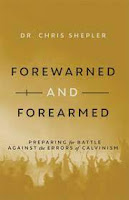
Among the many works available refuting Calvinistic theology the most recent, comprehensive and compelling I am aware of would be Forewarned and Forearmed: Preparing for Battle Against the Errors of Calvinism by Dr. Chris Shepler. 
"Forewarned and Forearmed will walk you through the five major tenets of Calvinistic theology of represented by the acronym TULIP. It will explain what Calvinists mean and teach by each of them. It will also expose Calvinism's error and show how it is truly misaligned with the clear teaching of the Bible."
Footnotes:
1) Steve Lawson: Professor of Preaching at The Masters Seminary (John MacArthur, chancellor emeritus), member of The Gospel Coalition. 

For the 2023 BJU Foundations Conference five-point Calvinist Steve Lawson was presented as a keynote speaker. This was further evidence that BJU has adopted Calvinism and Reformed theology are core doctrines to be taught and promoted in the college and seminary. See also, An Analysis of BJU's Position Paper on Calvinism, Arminianism & Reformed Theology.

2) The Long Line Continues (Feb. 6, 2019 edition).

3) The key to understanding Calvinism’s irresistible grace is that the Holy Spirit regenerates the elected individual, thus, they can then receive the Word and exercise faith. This regeneration can occur years before exercising their act of faith. Some Calvinist’s define this regeneration as taking place at conception, others at physical birth, and others at some later time. But ALL Calvinist’s teach it occurs prior to and independent of any act of faith or any foreseeing by God of their eventual faith. When thought through, biblically to be regenerated, literally meaning to “be born again,” means that the elect one possesses or is indwelled by the Holy Spirit at that point. For further study see,
The Danger of Teaching That Regeneration Precedes Faith


5) Dr. David L. Cummins, in an email to me answering the question, what is rationalistic fatalism.  Dr. Cummins response appears on pp. 261-262 of In Defense of the Gospel: Biblical Answers to Lordship Salvation, 1st edition only, 2006.

Related Reading:
After reading Bob Jones University’s position paper, I feel that it reflects a style commonly employed by many New Calvinists. Their writing typically skirts issues to avoid offense or exclusion, while maximizing inclusivity. They achieve this by allowing the reader to supply his or her own theological definitions rather than offering clear-cut ones that would reveal Calvinist views. The fact that BJU’s paper appears to use a similar strategy concerns me. I see this tendency through the paper. For example, it contains the term “exercise faith” four times. (Dr. Rob Congdon: An Analysis of Bob Jones Universitys Position Paper on Calvinism...)

Oops! I Thought I Was a Four-Point Calvinist & An Alternative View of Election


Defining Calvinism’s T-U-L-I-P?
Following is a succinct definition of T-U-L-I-P. Following each of the five-points we will reiterate the way Calvinists rename each of the five points.

T- Total (Human) Inability
The Bible teaches man’s human depraved nature, human depravity, – that is all have sinned and come short of the glory of God (Rom. 3: 23). All are sinners and separated from God.  Calvinism added the term “total” to the term human depravity, to indicated that apart from God’s intervention through the regeneration of the Holy Spirit prior to faith, man can never understand, accept, react, or respond spiritually in any way to God, His Word, and the work of the Holy Spirit. (Jer. 17:9; Romans 3:10-12; Eph. 2:1)
Lawson renames Total Inability, “Total Depravity,” or “Radical Corruption.”

U- Unconditional Election
For the Calvinist God has elected only a select group of the world’s population for Heaven, while all the rest enter this world headed to an eternal existence in Hell. Some Calvinists explain God taking an active role in bringing the elect to salvation, but as for the rest, He is completely passive toward, and essentially abandons them on the road to Hell. (2 Cor. 5:18-19)

Many Calvinists, however, teach that God elected some to heaven and some to hell – in other words, He did not just extend grace to some, the elect, and allow the others to follow their own path, independent of God’s electing them to Hell. It should be noted that most people believe in Calvinistic Unconditional Election or Arminianism, which allow them to reject God later after first trusting Him. It is important to realize that the Bible’s use of the term “election” always refers to service and never salvation; hence there is a third view of election, independent of both Calvinism and Arminianism.
Lawson retains “Unconditional Election,” or “Sovereign Election.”

L- Limited Atonement
Limited Atonement is the most controversial of the five points. Many in the Reformed camp back away from this point of Calvinism and call themselves four-point Calvinists. Many five-point Calvinists consider those who do not fully embrace a limited atonement as falling short of being a true Calvinist. The five-point Calvinist believes Christ died only for the elect; the shed blood of Christ and His atoning work on the cross were intended only for the select group chosen for salvation. This means Christ’s substitutionary death paid the penalty of sin only for certain sinners, and not for the sins of all mankind past, present and future. (Isaiah 53:6; John 3:16; 1 Jn. 2:2)
Lawson renames Limited Atonement, “Definite Atonement,” or “Particular Redemption.”

I- Irresistible Grace
Calvinism teaches that the Holy Spirit extends a special inward calling, but only to those elected to salvation. Through this calling the sinner is irresistibly drawn to Christ and the Spirit causes the sinner to cooperate. The lost man may have no desire for Christ, no interest in the claims of the gospel, but he has no choice in the matter. Because he has been unconditionally elected for salvation the Spirit puts the choice in his mind, removes any barrier or hindrance and compels him to respond to the gospel invitation.

Many indicated it is not necessary to respond to a gospel invitation. They describe an eventual realization that they are elect and rather than an act of response, they merely believe their spiritual interest and/or acknowledgement of Christ indicates they are elect. The Calvinist often uses the term “exercise faith” rather than trust in Christ alone for their salvation.

This irresistible grace cannot be rejected and does not depend on man’s cooperation. The ability of individuals to reject Christ’s offer of salvation answers Calvinism’s irresistible grace. The Bible teaches that man can be reproved over and over, and resist the working of the Holy Spirit in his heart. (Gen. 6:3; Prov. 1:24-26; 29:1; Matthew 23:37; John 5:40; Acts 7:51-52)
Lawson renames Irresistible Grace, “Effectual Calling,” or “Sovereign Regeneration.”

P- Perseverance of the Saints
There are two views on Perseverance of the Saints. The traditional position is found in Reformed confessions of faith. The non-traditional view is typically found in some Baptist and Evangelical circles. The common denominator is that the elect are eternally secure and will persevere in the faith. The way Perseverance commonly addresses those who fall away is to conclude they were never saved in the first place or will return eventually. In its most extreme form Perseverance is articulated (for example by John Piper and Kevin DeYoung) as the only way to ensure “final salvation,” of final justification, to reach heaven, i.e., glorification.

To the Calvinist, a person must persevere their entire life by doing good works and spiritually living to demonstrate at the Great White Throne Judgment that they are truly elect. Thus, all men will appear at the Great White Throne Judgment (Rev. 20:11-15). Notice they are judged by their works. You often read in Calvinistic writing that a person cannot truly know they are righteous or the elect until the day they die, but Scripture says you can know you have eternal life right now (1 John 5:13). For the true believer who has accept God’s gift of salvation by faith alone, he does not have to persevere but depends upon God to preserve Him as promised in Jude 1 and Jude 24.

Thus, a saved man’s eternal security, his assurance and position in Christ are not dependent on how he performs as a Christian. He is saved and secure because of what Jesus Christ has done for him. (John 10:28-29; Eph. 1:13; 2 Tim. 1:12; 1 Peter 1:3-9Lawson retains Perseverance of the Saints,” or “Persevering or Preserving Grace.”

May 1, 2023

Archival Series- Transitional Fundamentalism

 There are many non-negotiables for New Testament believers. Most certainly the fundamentals of the faith are never open for dialogue or debate. Even those who are currently in transition away from the Fundamentalism of the past admit that there are some issues upon which there can be no compromise without departing from the Word of God. The emphasis of Scripture for believers is not upon change but upon stability.

Dr. Milton Jones

1 Corinthians 15:58 Therefore, my beloved brethren, be ye steadfast, unmovable, always abounding in the work of the Lord, forasmuch as ye know that your labour is not in vain in the Lord.  
1 Peter 5:8, 9 Be sober, be vigilant; because your adversary the devil, as a roaring lion, walketh about, seeking whom he may devour: Whom resist steadfast in the faith, knowing that the same afflictions are accomplished in your brethren that are in the world. 
Acts 2:42 And they continued steadfastly in the apostles’ doctrine and fellowship, and in breaking of bread, and in prayers.  
Colossians 2:5 For though I be absent in the flesh, yet am I with you in the spirit, joying and beholding your order, and the steadfastness of your faith in Christ.
We are continuously warned to be aware of the temptation to compromise and accommodate the ever present pressure to change.
2 Peter 3:11-18 Seeing then that all these things shall be dissolved, what manner of persons ought ye to be in all holy conversation and godliness, Looking for and hasting unto the coming of the day of God, wherein the heavens being on fire shall be dissolved, and the elements shall melt with fervent heat? Nevertheless we, according to his promise, look for new heavens and a new earth, wherein dwelleth righteousness. Wherefore, beloved, seeing that ye look for such things, be diligent that ye may be found of him in peace, without spot, and blameless. And account that the longsuffering of our Lord is salvation; even as our beloved brother Paul also according to the wisdom given unto him hath written unto you; As also in all his epistles, speaking in them of these things; in which are some things hard to be understood, which they that are unlearned and unstable wrest, as they do also the other scriptures, unto their own destruction. Ye therefore, beloved, seeing ye know these things before, beware lest ye also, being led away with the error of the wicked, fall from your own steadfastness. But grow in grace, and in the knowledge of our Lord and Saviour Jesus Christ. To him be glory both now and for ever. Amen. 
Jude 3 Beloved, when I gave all diligence to write unto you of the common salvation, it was needful for me to write unto you, and exhort you that ye should earnestly contend for the faith which was once delivered unto the saints.
This is not to suggest that Biblical faith is static. Quite the contrary, it is very dynamic! This dynamic however does not lie in finding ways to be flexible with truth in order to fit a changing culture. The dynamic of Biblical faith lies in its unchangeableness and eternal power to confront the culture demanding a submissive response. In other words, Biblical Christianity is not about making the Bible fit the culture; it is about calling upon people in the culture to submit to the authority of Scripture.

The Winds of Change
There is a sense in which people have always been in motion away from Biblical faith. It is the result of the strong vacuum pull of unbelief. In the 1970’s and early 1980’s Fundamentalism saw a significant defection centered in Lynchburg, Virginia and spreading through the sphere of influence dominated by Jerry Falwell. At that time those who were in motion were called “Pseudo-Fundamentalists” and then “embryonic New Evangelicals.” Those who shifted during that time frame have now arrived as full-fledged New Evangelicals. Then as now, decisions were made, sides were chosen, and separations in fellowship followed.

Rather than trying to coin a phrase to describe what has been going on in Fundamentalism over the last number of years, we would serve a better purpose by simply referring to those who are in motion as Transitional Fundamentalists. The very word “transition” indicates movement. Motion is not inherently evil. Walking with God (Genesis 5:22, 24) implies motion. The real question has to do with direction. In what direction are the feet of Transitional Fundamentalists pointed?

One of the spokesmen for those in transition has called for a “radical center” in which conservative evangelicals and fundamentalists in transition can find a home.1 The vision articulated indicates that Conservative Evangelicals are moving to the right and certain fundamentalists which the author characterizes as “mainstream” are moving to the left to meet in the “radical center.”

The problem with that model is the reality that Conservative Evangelicals are not moving at all. While they have become more vocal in decrying the radical shift to the left within the evangelical world, conservatives within that world stand exactly where the movement has stood since its inception. The only people who are actually moving are the Transitional Fundamentalists. There really is no “radical center.”

The New Direction
The evidence of movement toward New Evangelicalism is found in the very spirit of accommodation that has long characterized that movement. There is little question that many from the fundamentalist camp have embraced various forms of Contemporary Christian Music. Some have attempted to alter the scores from Sovereign Grace Music in order to utilize the lyrics. Others have succumbed to the sirenic allurement of new sounds. Others are responding to consumer demand for music that emulates that which the world produces. As controversial as music issues often are, the direction in which the musical feet are pointed have historically been telling of where the theological feet will soon follow.

Another characteristic of this movement is the increasingly casual atmosphere created in previously fundamental ministries. No real fundamentalist insists upon a dead somber approach to the worship of God; but neither is he looking to soften edges by dressing casually for church or opting for entertaining environments. A tuxedo is hardly required for the pulpit but a reasonable suit and tie would be nice. The attire is not the issue; the attitude is the issue.

In no area is the fact of transition more apparent than the willingness to closely associate with the Scripturally disobedient.

Increasingly there is “pulpit swap” between Conservative Evangelicals and Fundamentalist ministries. In that process the evangelical is promoted and the resolute Fundamentalist is vilified. Every pastor of an autonomous church is free to bring whomever he will to his pulpit but he must realize that in the choices he makes he is also authenticating the position of every guest speaker. A willingness to become participants in the Together for the Gospel and Gospel Coalition movements are clear indications of a change in method as well as direction.

Fundamentalists do not have anything theologically that New Evangelicals want or think that they need. They want access to our people, institutions, and finances to be utilized for purposes other than those for which they were established.

Why are They Moving?
It must also be recognized that the nuclear glue for the new coalition that is forming is undoubtedly Reformed Theology. Reformed Theology with its covenant perspectives, open church membership, and increasingly radical Calvinism is the new impetus for a new brand of ecumenism. As surely as the foundation of New Evangelicalism found its roots in men from the Reformed Tradition, so is the appeal to Transitional Fundamentalists. The show of intellect and evident scholarship has captured a generation of younger preachers. There have always been Calvinists in the Fundamentalist Movement but their Calvinism has never been the cause. The greatest case in point was C. H. Spurgeon. In the last great battle of his life, the Downgrade Controversy, he demonstrated that fidelity to truth superseded his personal understanding of the mechanics of soteriology. It is not accidental that concurrent with the approachment of evangelicalism by those in transition from Fundamentalism there has been an acceptance of the Reformation Bible (ESV) on a broad scale.

Whatever your position on textual issues, it is a plain fact that this reworking of the old liberal Revised Standard Version has been designed to be the Bible of a renewal of Reformed Theology.

It is incredibly sad that we learn so very little from history. There has never been a more stridently Calvinistic pastor than John Gill in the eighteenth century. It is most revealing that charges of antinomianism were levied against those who were associated with him. Antinomianism refers to a rejection of rules of conduct. It is strange that a theology that purports to honor the majesty and holiness of God should be guilty of worldliness to excess.
It is very much a part of the Transitional Fundamentalist mindset to raise debate about issues that have been long settled in the hearts of godly people.
Fundamentalists have long believed in personal separation as well as ecclesiastical separation. This translates to a rejection of the use of alcohol as a beverage as well as other overtly worldly practices. Standards of modesty and conduct are as Biblical as the major doctrines. Increasingly Transitional Fundamentalists dismiss such discussions as irrelevant and characterized them as the restrictions of a past tense Fundamentalism. It should be noted that failures in ecclesiastical separation usually precede the erasure of standards of personal separation. The “spiritual pride” that would countenance worldliness as insignificant appears to parallel the pride of intellect too often found in Reformed circles.

The Danger
Fundamentalists cannot “live and let live” in this matter. Disastrous effects are already accruing. Several institutions, agencies, and many churches have already been delivered into the hands of compromise. It is to be feared that there will be no return for these because their leaders seem to think that they are doing God service (John 16:2) by “reclaiming authentic fundamentalism.”2

Sadly the “authentic fundamentalism” claimed is bereft of accurate history and intellectual integrity.

Worse, a whole new generation of believers will be influenced to embrace compromise as normative Christianity. This is especially true since the centers of learning that were previously well within the Fundamentalist Movement, are training a new generation of leaders to imbibe the transition to Evangelicalism as wholesome and desirable. Perhaps the most dangerous aspect of this tragic transition is its drafting effect. Everyone who has experienced the rapid passage of a large vehicle has felt the motion effect in the direction the vehicle was travelling. The larger the vehicle and the greater the speed, the greater will be the effective draft. It is to be feared that more and more institutions, agencies, and churches will be drawn toward Conservative Evangelicalism. At the moment at least it has the appearance of some resurgent success in articulating conservative values and gaining the public ear. Beware of pragmatism that would ride the coattails of this compromise. Disobedience cannot bring about revival. Only God-sent Biblical renewal can stem the tide of political liberalism and religious apostasy. A major component in revival is repentance and restoration to obedience to the authority of Scripture.

We must also recognize the minimalism inherent in this movement. The core of the Bible is not the gospel! The core of the Bible is Christ! Much is being said about the gospel, its definition, and the need for its promulgation. Fundamentalists embrace the necessity of the gospel but do not reduce Biblical Christianity to a general agreement about the gospel. It is the old paradigm battle that has reappeared many times in the past. Will we be soteriological in approach or doxological? Preaching the gospel glorifies God but so does obedience. A gospel preached at the behest of disobedience will eventually become a compromised gospel. It has in the past and will be again.

As Transitional Fundamentalists crusade for change we must be aware that the change envisioned is not a return to orthodoxy and orthopraxy; it is a compromise of the truth. It is informative to note that mainstream evangelicals have gone on record as stating that there is no appreciable difference between Conservative Evangelicalism and Fundamentalists who are in transition.3

How Shall We Respond?
We must be found in the same heart and mind evidenced by our Lord in the first letter to the churches of Asia Minor.
Revelation 2:5 Remember therefore from whence thou art fallen, and repent, and do the first works; or else I will come unto thee quickly, and will remove thy candlestick out of his place, except thou repent.
This is the ever present ministry of reproof and challenge to people who are genuinely saved, but sadly disobedient.
Further we must refuse to surrender resources to those institutions, agencies, and churches who are moving. 
It is not wise to continue to send our children to colleges, give our money to agencies, or support churches that are in transition while we wait to see where they will land. By then it is too late! Look at where their feet are pointing! At some point there must be separation from this disobedience. It is the only tool which God has given to us to police ourselves and to maintain the priority and purity of our position.

In doing these things, we need not expect to be applauded. Regardless of how lovingly we reprove and how carefully we withdraw fellowship we will be labeled as unloving and judgmental. We do not judge in order to condemn; that is God’s business. We judge righteous judgment to the end that we may maintain obedience and fidelity to the truth.

We will one day (short of the Rapture) become part of a new remnant. Every age has its remnants. We exist today as Fundamentalists because of previous remnants. We must not fear being marginalized, vilified, or even persecuted. We must fear to compromise. We must endeavor with all that is within us to honor God above men, truth above movements, and faithfulness above success. We must be sensitive to the Holy Spirit so that we can take our stand without a censorious spirit, without pride, and with compassing desire to see our brethren recovered from the error of their decisions.


Dr. Milton Jones
Originally published May 2013


1) Douglas R. McLachlan, “Moving Toward Authenticity: Musings on Fundamentalism” posted on the website of Northland International University

2) Ibid.

3) See, Four Views on the Spectrum of Evangelicalism, edited by Andrew David Naselli and Collin Hansen, (Grand Rapids: Zondervan, 2011.)

Reprinted with Permission:
Indiana Fundamental Baptist Fellowship
News & Views
March 2013 ~ Issue 31
Pastor Rick Arrowood, President

January 23, 2023

Bob Jones University Foundations Conference: An Intrusion of Reformed/Covenant Theology, New Calvinism & Lordship Salvation

Key Speakers at the Foundations Conference at BJU Dec. 8-9, 2022
Conference organized by SermonAudio

Dr. Steve Pettit: BJU President
Only days after the contested renewal of his presidency.

Dr. Steven J. Lawson:
Is Reformed throughout in his Theology.
• Is on the board at John MacArthur’s Master’s Seminary, where he also serves as
Professor of Preaching, and oversees the Doctor of Ministry program.
• Is a graduate of Reformed Theological Seminary (DMin).
• Serves as the Executive Editor for the Reformed Expositor Magazine.
• Is a Teaching Fellow for Ligonier Ministries, where he serves on its board. 

Ligonier Ministries is a Reformed organization in the greater Orlando, Florida
area. Ligonier was founded in 1971 by R. C. Sproul in the Ligonier Valley,
outside Pittsburgh. In their magazine “Tabletalk,” R. C. Sproul, Sr. and R. C.
Sproul, Jr. endorsed a book titled, Aquinas was a Protestant, written by John H.
Gerstner. In 1567, the Roman Catholic Church had declared Thomas Aquinas
(1224-1274) a Doctor of the Church (Doctor Angelicus). In 1823, Pope John XXII
had canonized Aquinas. In 1879, an encyclical of Pope Leo XIII had decreed
Aquinas’ theology to be the definitive exposition of Roman Catholic doctrine. All
Roman Catholic seminaries and universities are to teach Aquinas’ doctrines.
Despite all that, John Gerstner insisted that Thomas Aquinas “taught the biblical
doctrine of justification so that if the Roman church had followed Aquinas the
Reformation would not have been absolutely necessary” (page 14). Ligonier
Ministries published the book.

Paul Washer:
• Completed his undergraduate studies and enrolled at Southwestern Theological
Seminary, where he received his Master of Divinity degree.
• Is a Southern Baptist Convention evangelist.
• Is strongly Reformed in his doctrine.

Dr. Joel R. Beeke (b. 1952):
• Is a Reformed pastor and theologian.
• Received his PhD at Westminster Theological Seminary; his dissertation is on
Reformation and Post-Reformation theology.
• Is a minister of the Heritage Reformed Congregation in Grand Rapids, Michigan.
• Is President of the Puritan Reformed Theological Seminary and is the professor
of Systematic Theology and Homiletics.
• Wrote the 3- volume Reformed Systematic Theology.
• Is editor of “The Banner of Sovereign Grace Truth.”
• Is editorial director of Reformation Heritage Books. 
• Is president of Inheritance Publishers and vice-president of the Dutch Reformed
Translation Society.
• Is frequently called upon to lecture at Reformed seminaries and to speak at
Reformed conferences around the world.

Armen Thomassian: The minister of Faith Free Presbyterian Church, Greenville SC,
since January 2019.

Bob Vradenburgh: Pastor of Friendship Baptist Church, Raleigh, NC.

Below is from the BJU website
We have assembled an incredibly unique combination of speakers including Steven Lawson, Paul Washer, Steve Pettit, Joel Beeke, Armen Thomassian, and Bob Vradenburgh. It is a rare occurrence to have such diverse men all together at a single event so we're looking forward to a very special time of Christian unity and friendship.

We are pleased to be partnering with Reformation Heritage Books for this event.... They will be offering a broad array of classic works at a steep discount for conference attendees along with a free gift. Be sure to take advantage of this special offer.


LM

Related Reading:

"New Calvinism is a system of theology that combines: Reformed, Covenant, Puritan, and Augustinian theologies with present day, Post-Modern culture in an attempt to make Christianity seem more relevant to today’s Christian. Recognizing that churches are declining in numbers, fewer people are being saved, and that many Christians are carnal, not leading holy lives, concerned Christian leaders are looking back to the earlier days of the church for a solution. One solution they are turning to is New Calvinism. They are re-thinking and re-invigorating their teachings in order to make it relevant to our generation of Christianity. 1) Relevant is a key goal of New Calvinism. 2) Adherents to New Calvinism believe that the answer lies in reaching out and building bridges between all segments of Christianity. 3) According to the teachings of New Calvinism, the spiritual gifts of signs and wonders are valid for the church today. 4) New Calvinism seeks to create and redeem culture. 5) New Calvinism unites with Worldliness."
"BJU may not officially be a Reformed or Calvinist school. But its recent publications suggest an awareness and endorsement of Reformed/Calvinist thought and teaching.... If...BJU is following the pattern exhibited by New Calvinist writing, then there is a much deeper problem at work requiring immediate action to reverse this intrusion of Reformed and Calvinist theology."
"The new Calvinism is not a resurgence, but an entirely novel formula which strips the doctrine of its historic practice, and unites it with the world.... New Calvinists do not hesitate to override the instinctual Christian conscience, counseling people to become friends of the world."
"After being the premier fundamentalist academic institution for eighty-seven years, BJU elected Dr. Steve Pettit in 2014, as the president who steered the University out of separatist Fundamentalism into the inclusive, Broad Evangelical movement," David Beale, Christian Fundamentalism in America
Lordship Salvation is a works based, non-saving message that corrupts the simplicity that is in Christ (2 Cor. 11:3) and frustrates grace (Gal. 2:21).
Franklin Graham, like his father before him, gives Christian recognition to the "enemies of the cross of Christ" (Phil. 3:18). Cooperating with Franklin Graham was an act of sinful disobedience to the Word of God. It is an egregious example of ecumenical compromise at BJU that was heartily endorsed by Dr. Steve Pettit.

Addendum (Jan. 24, 2023):

At the SermonAudio site is a lengthy page dedicated to promotion of the Foundations Conference. In fairness, the conference held at BJU was largely organized by SermonAudio with the complete cooperation and assistance of the university. That established following is an excerpt.

"I am always personally blessed by these conferences because of the unique assembly that takes place between brethren that don't normally gather together. The Foundations Conference does not tie itself down to a particular denominational label or theological stripe. But, like SermonAudio's Articles itself, it is an attempt to promote Christian unity around essential truths that we can all agree on -- namely, the importance of the Word and prayer." (I was not able to identify the author)

For a moment, reflect on, "...does not tie itself down to a particular denominational label or theological stripe." For those of us who remember does that statement not appear eerily similar to the sixth of seven promises of a Promise Keeper? Promise Keepers #6 UNITY, "A Promise Keeper is committed to reach beyond any racial and denominational barriers to demonstrate the power of biblical unity.By "denominational barriers" they meant to set aside any doctrinal barriers, especially the doctrinal barriers of separation, to have their unity.